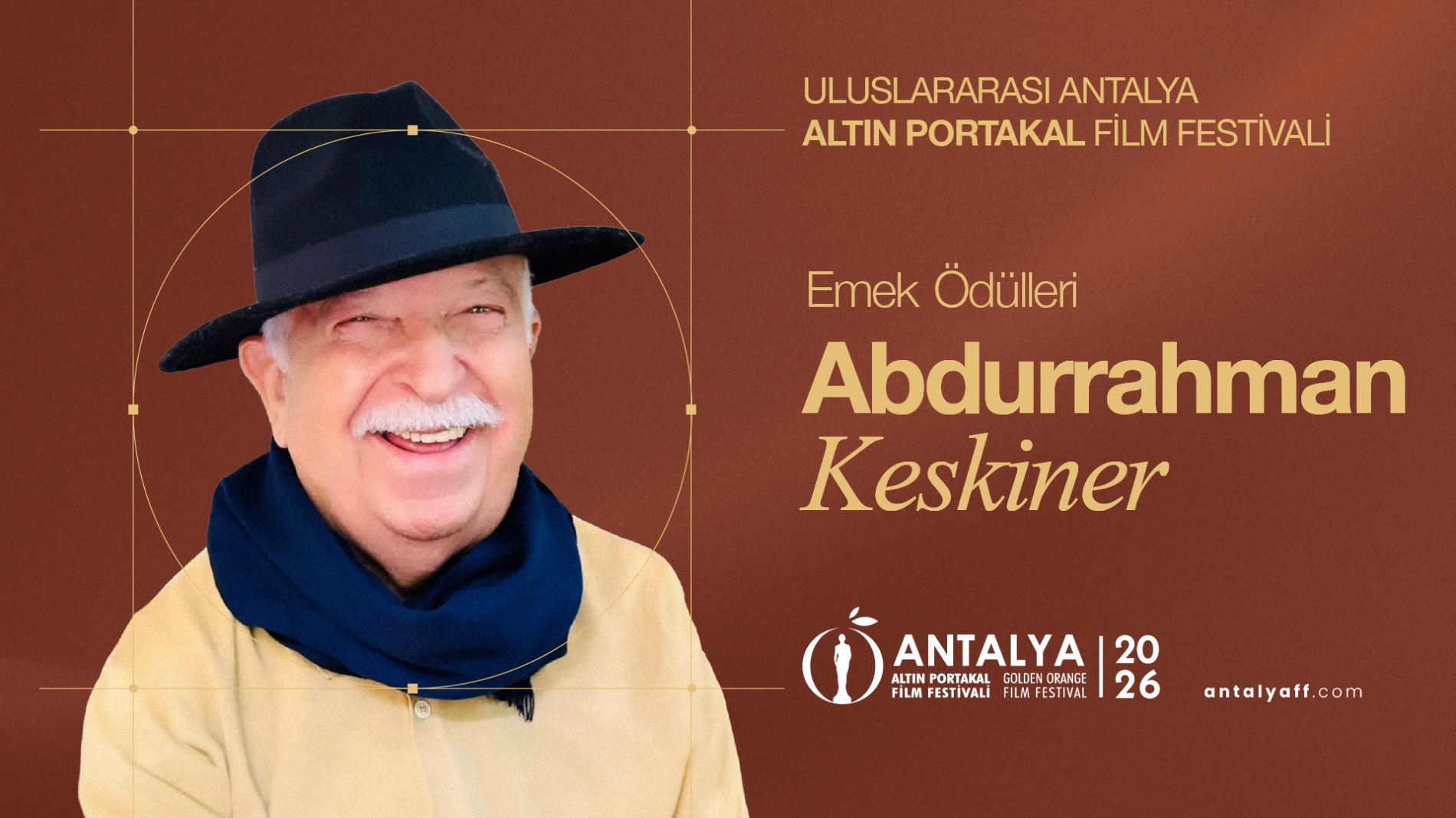
At the International Antalya Golden Orange Film Festival—Turkey’s longest-running film festival, which will take place from October 24 to 31, 2026—this year’s “Cinema Achievement Award” will be presented to Abdurrahman Keskiner.
Producer Abdurrahman Keskiner, who was honored with the Cinema Labor Award at the 63rd Antalya Golden Orange International Film Festival, was born in 1941 in Osmaniye, Türkiye. He completed his primary, secondary, and high school education in Osmaniye, spending his final year of high school at Atatürk Boys' High School in Beyoğlu, Istanbul. For a period, he worked as a substitute teacher in Büngüş Village, in the Karaisalı district of Adana. In 1965, Keskiner entered the film industry as the manager of Yılmaz Güney, and in 1966, the two founded Güney Film. The films he produced soon achieved significant success, with Bir Çirkin Adam winning the First Prize at the Antalya Film Festival in 1969. In 1971, Keskiner parted ways with Yılmaz Güney and established Umut Film, under which he produced 72 films. Abdurrahman Keskiner is also the elder brother of acclaimed filmmaker Arif Keskiner, who passed away in 2024.
Abdurrahman Keskiner brought many of the landmark productions of Turkish cinema to audiences, including Umut, Muhsin Bey, Hazal, Yılanı Öldürseler, Kuduz, Rabia, Namus Borcu, El Kapısı, Çirkef, Fotoğraflar, Sabuha, Fadile, Ceylan, Zeynep, Rüzgar, Gülbeyaz, Kaplan Pençesi, Sensizliğe Alışacağım, Anılar and Yağmur Altındaki Kedi. In addition to his work in cinema, Keskiner also produced for television. In 1989, he produced the eight-part television adaptation of Orhan Kemal’s Hanımın Çiftliği; in 1990, the three-part Itri for TRT; and in 1993, the 15-episode series Kırmızı Kart Osman, which aired on Show TV. He also produced the documentary Anadolu Evlenme Gelenekleri ve Düğün Törenleri (Anatolian Marriage Traditions and Wedding Ceremonies) for TRT.
The films produced by Abdurrahman Keskiner received numerous awards at national and international festivals, while also achieving significant recognition in world cinema. Umut became the first Turkish film to be screened in the Directors' Fortnight (Quinzaine des Réalisateurs) section of the Cannes Film Festival in 1970. Namus Borcu won the Best Original Score Award at the Antalya Golden Orange Film Festival in 1974. In 1980, Hazal became the second Turkish film to be screened in the Directors' Fortnight at the Cannes Film Festival and made history as the first Turkish film to be nominated for the Caméra d'Or.
That same year, Hazal won the Best Film Award at the San Sebastián International Film Festival, the Grand Jury Prize at the Prades Film Festival, the Golden Ducat Award, the Catholic Jury Special Award, and the Audience Jury Award at the Mannheim International Film Week, as well as the Best Film Award at the The Hague International Film Festival and the Golden Butterfly Award for Best Film of the Year. The film was also screened at the London Film Festival. In 1981, Hazal received the Best Film Award at the Turkish Cypriot Film Days and was screened at the Los Angeles, Hong Kong, and Sydney film festivals. It was later included in the official selections of the Carthage Film Festival in 1982 and the Alexandria Film Festival in 1984. Yılanı Öldürseler won the Golden Butterfly Award for Best Film of the Year in 1983 and was screened at the Cairo International Film Festival in 1984. In 1987, Muhsin Bey received the Best Film, Best Actor, Best Supporting Actor, Best Screenplay and Best Original Score awards at the Antalya Golden Orange Film Festival. The following year, it won the Special Jury Prize at the Istanbul Film Festival and the Donostia Award at the San Sebastián Film Festival, and was also screened at the Tashkent and Sicily Mediterranean film festivals. After receiving the Cinema Achievement Award from the Turkish Ministry of Culture in 1989, Muhsin Bey was followed by the television series Hanımın Çiftliği, which won the Best Television Series of the Year award from Kelebek newspaper. That same year, Hazal was screened once again at the Munich Turkish Film Days and the Strasbourg Turkish Cinema Days, while Fotoğraflar and Gülbeyaz were selected for competition at the Antalya Golden Orange Film Festival. In 1992, Sayın Başkan competed at the Antalya Golden Orange Film Festival, and in 1995, Hazal returned to audiences through special screenings at the Strasbourg Turkish Cinema Days and the Istanbul Film Festival. In 2014, Muhsin Beyreceived the Best Drama Film Award in the Top Ten Turkish Films of the Century awards presented by the Türsak Foundation and the Beyoğlu Municipality as part of the centennial celebrations of Turkish cinema. In recognition of his outstanding contributions to cinema, Abdurrahman Keskiner was also honored with the Honor Award at the International Dadaş Film Festival in 2013, the Lifetime Achievement Honor Award at the International Lions Short Film Festival in 2015, the Lifetime Career and Honor Award from the Foundation for Barrier-Free Living in 2016, the Honor Award at the Frankfurt Turkish Film Festival in 2017, and the Special Jury Award for Lifetime Contribution presented by Rotary International District 2430 in 2021.
In addition to his contributions to cinema, Abdurrahman Keskiner has made lasting contributions to his hometown of Osmaniye in the fields of education, culture, and healthcare. Through the Keskiner Foundation, he supported the construction of the Emine Keskiner Provincial Public Library and played a leading role in establishing the Hasan Keskiner Health Center the Abdurrahman Keskiner Health Center and the Abdurrahman Keskiner Fine Arts High School, which bears his name.
The Cinema Labor Awards of the 63rd Antalya Golden Orange International Film Festival will be presented to their recipients during the festival's opening ceremony on Saturday, October 24, 2026.