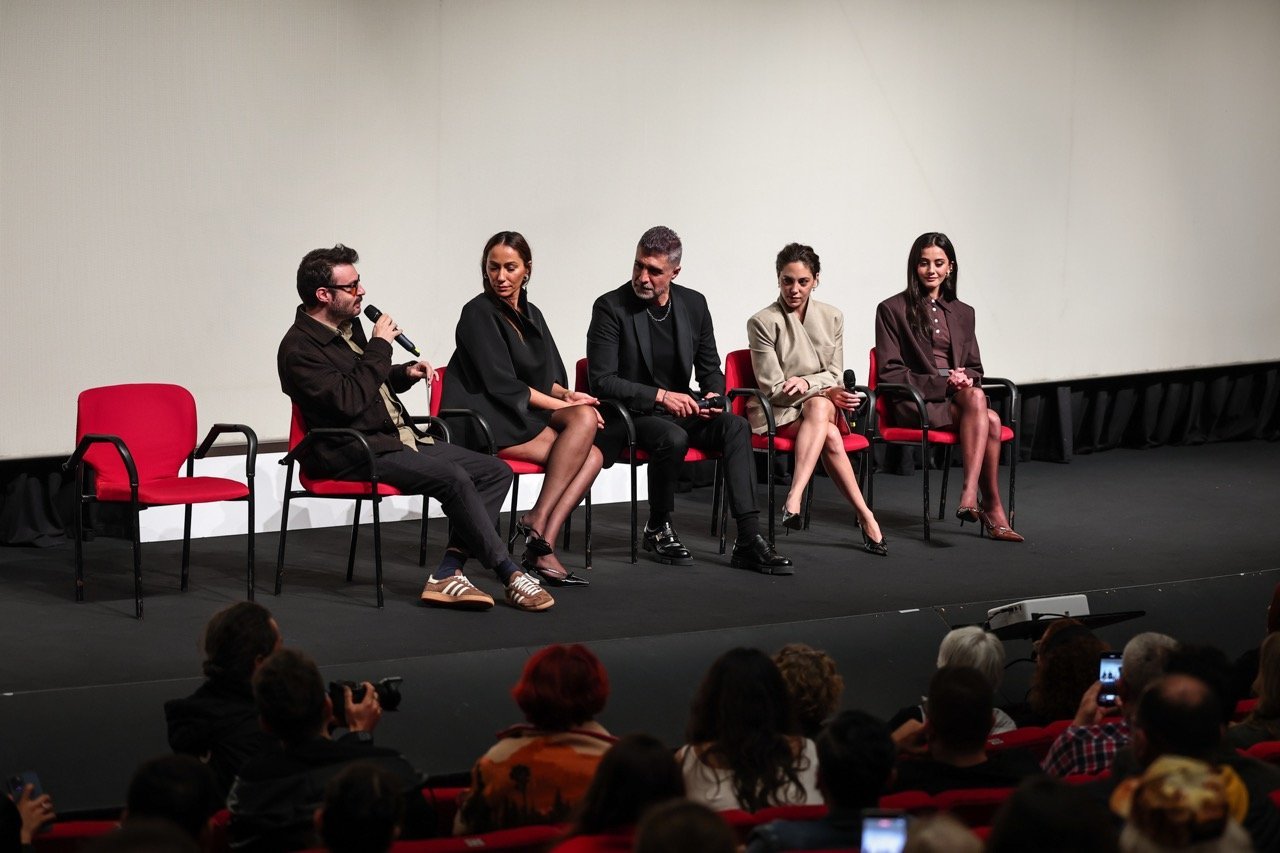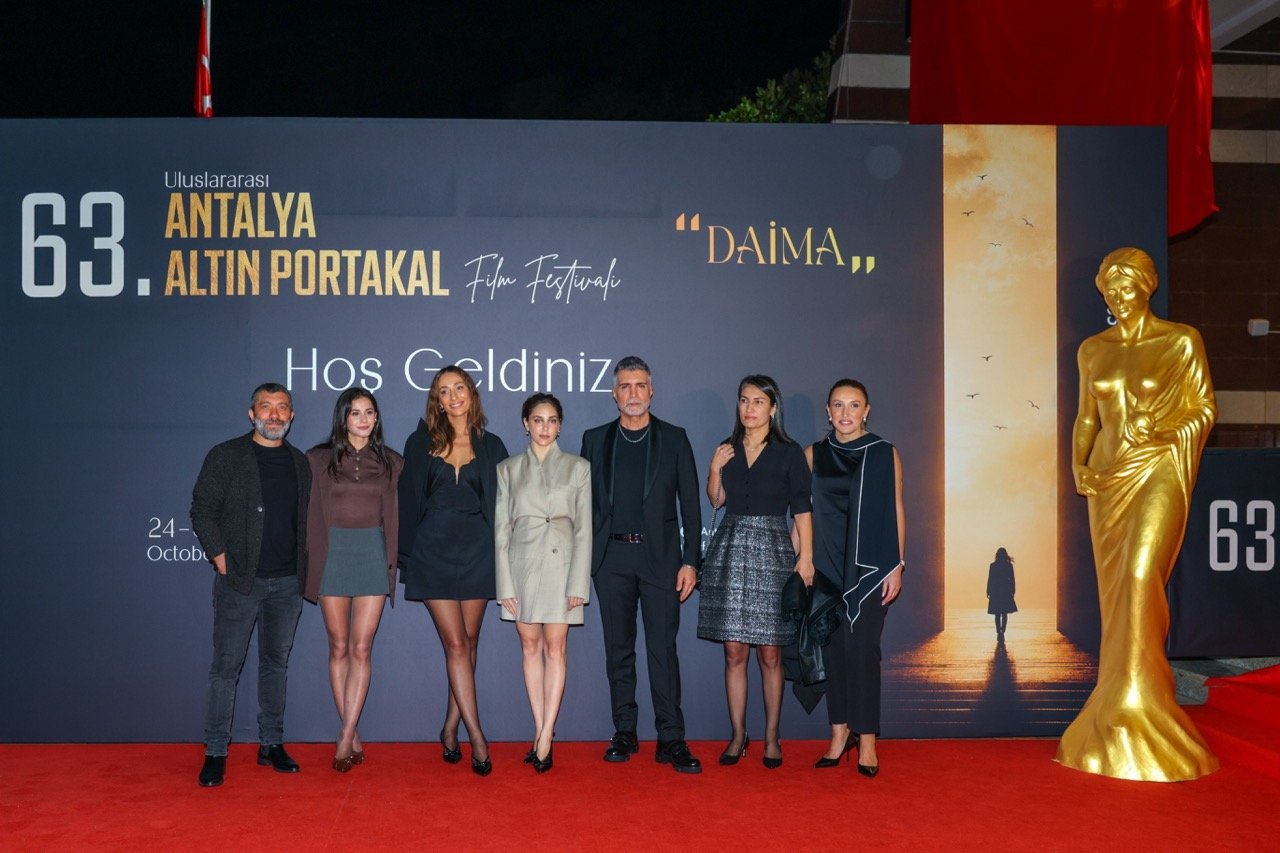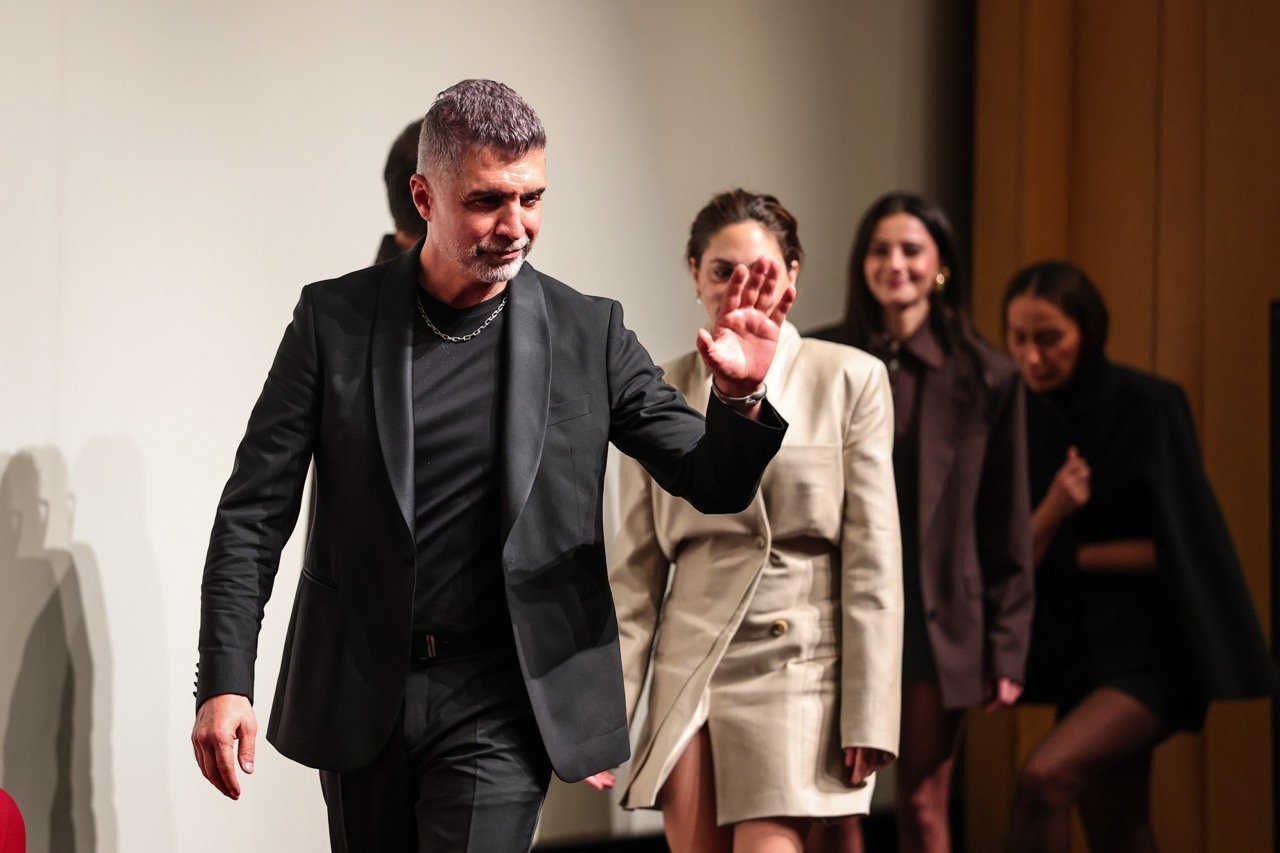
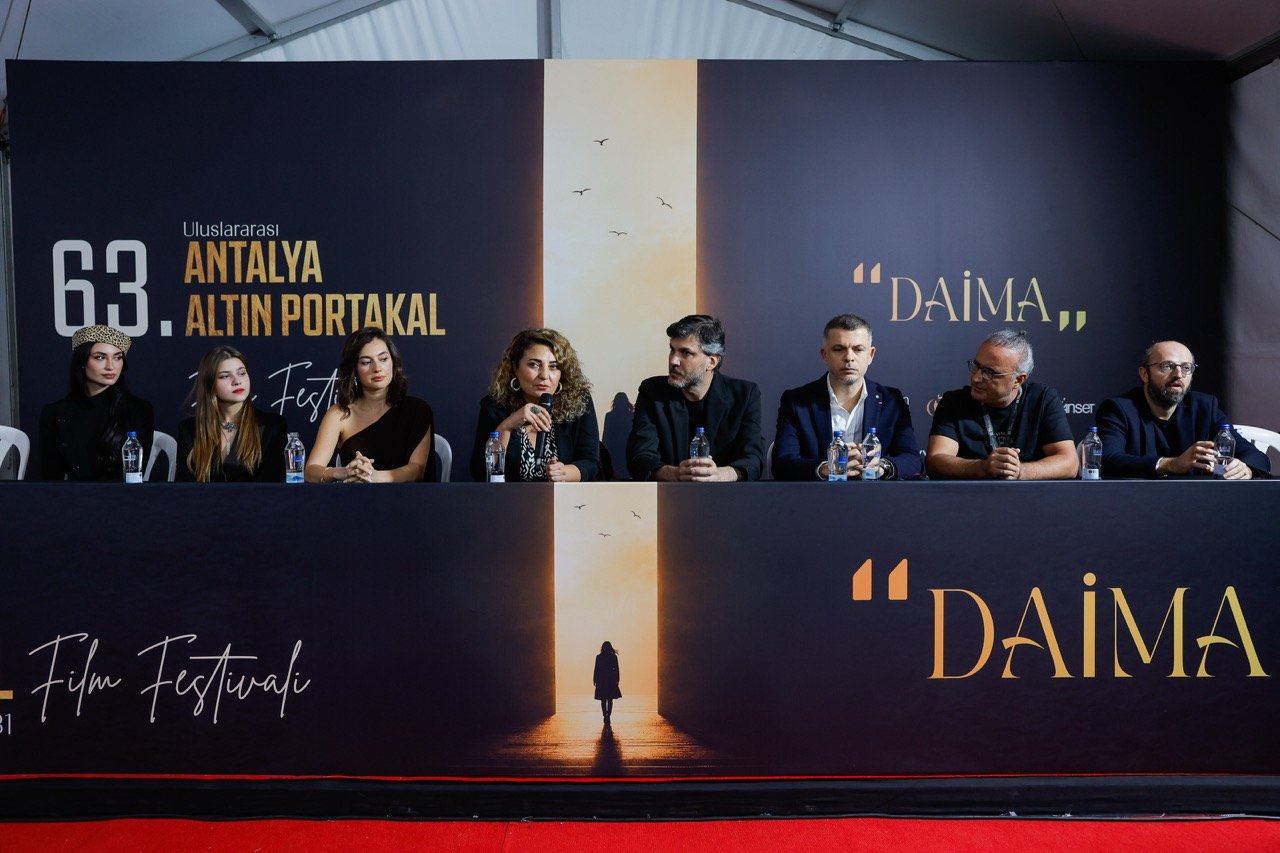
As the Golden Orange competition approaches its conclusion, two contenders, “Selma” and “Cinlerin Düğünü” (The Wedding of the Jinn), met with film enthusiasts today. The gala screening of Özcan Deniz’s new film “Son Yemek” (The Last Supper) was also held.
As the 63rd International Antalya Golden Orange Film Festival draws to a close, two competition films, “Selma” and “Cinlerin Düğünü”, met with audiences today, while Özcan Deniz’s new film “Son Yemek” held its Turkish premiere.
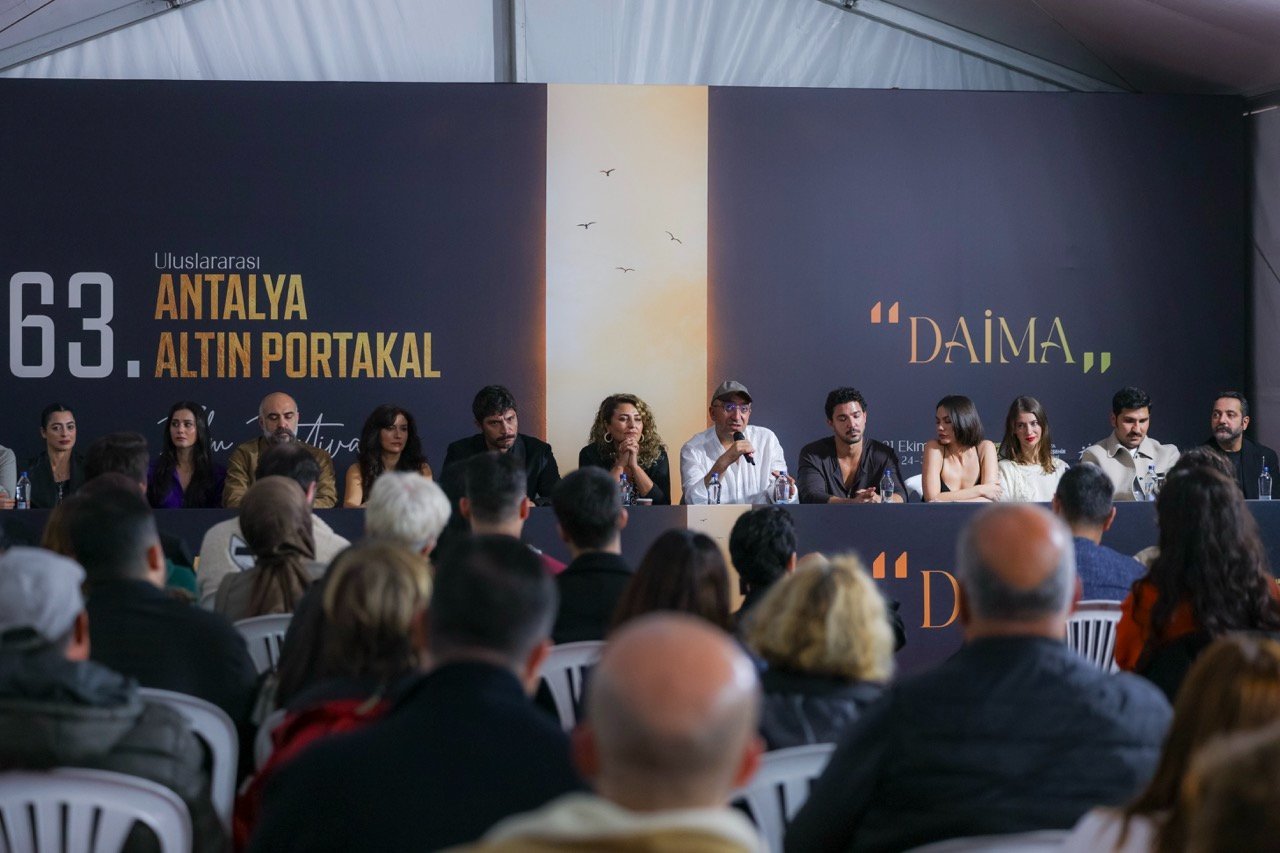
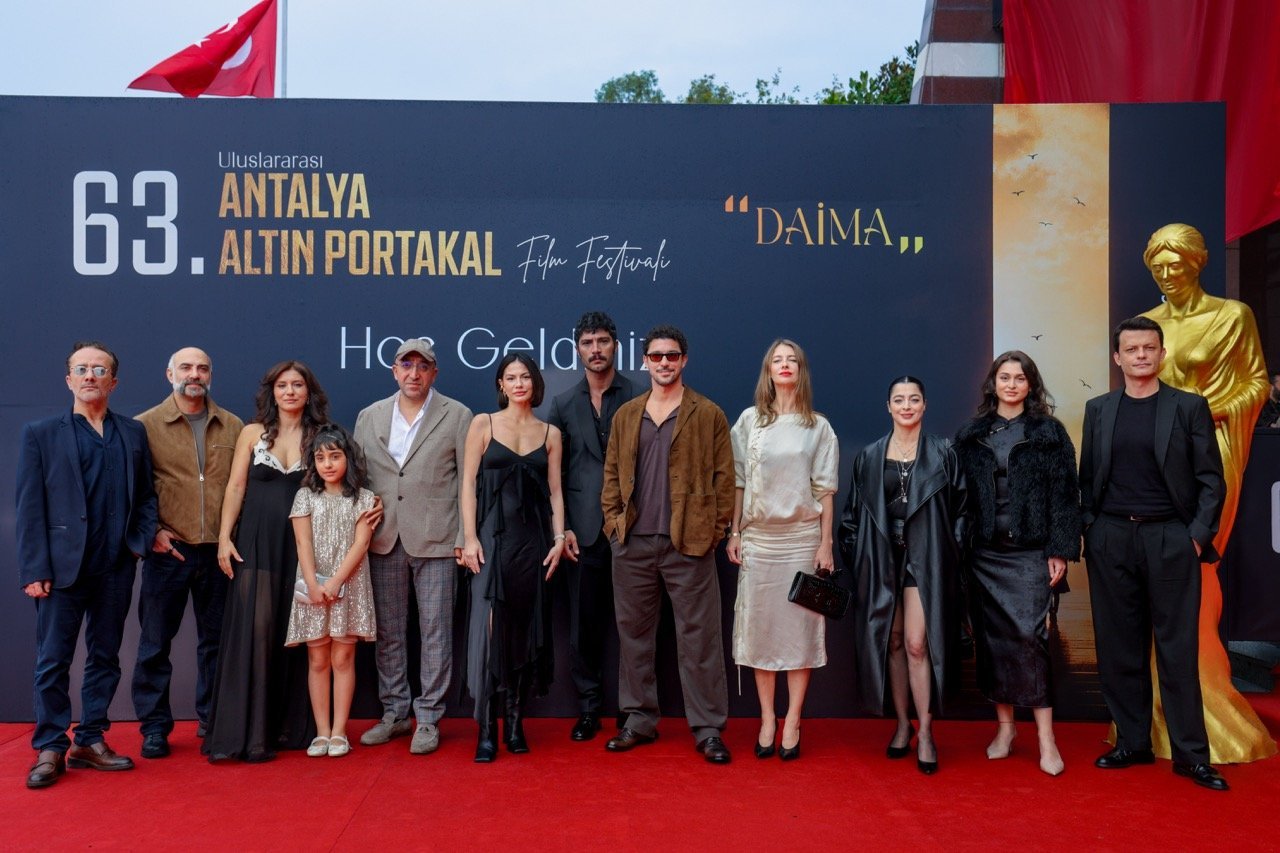
The new film “Cinlerin Düğünü” by Golden Orange award-winning director Ferit Karahan, which had its world premiere at the Toronto International Film Festival, was presented to Turkish audiences at the Atatürk Cultural Center (AKM) Aspendos Hall. Following the screening, director Ferit Karahan and cast members Demet Özdemir, Kaan Yıldırım, İlhan Şen, Helin Kandemir, Erol Babaoğlu, Tuba Ünsal, Mine Çayıroğlu, Kubilay Çamlıdağ, Evliya Aykan and Gürhan Altundaşar took part in a Q&A session.
“I wanted to create chaos that works like memory”
The director spoke about the origins of “Cinlerin Düğünü”, which tells the story of four siblings who reunite years later in a remote Anatolian village and confront their past during their sister’s wedding:
“I make modest, formalist, poetic films, but this one deals with broader issues such as global politics and social criticism. I always start by writing a sentence and building an idea around it. The first sentence was: Can a person who cannot confront their own darkness transcend their fate? When we fail to confront our dark sides, we create enemies out of them. Over time, these enemies multiply to such an extent that we end up becoming their puppets.”
In response to a comment suggesting that “Cinlerin Düğünü” has a different tone from his previous films, the director said:
“It is not actually that different from ‘Cennetten Kovulmak’ and ‘Okul Tıraşı’. Both ‘Cennetten Kovulmak’ and ‘Okul Tıraşı’ were films in which I drew on certain fragments of my own memory and presented them to the audience. This film, however, has a more intricate tone, one that resembles memory itself. It moves back and forth, magnifying some things while diminishing others, because that is how human memory works. I wanted to create chaos that functions like memory. I wanted the entire film to envelop the viewer like a nightmare. It is somewhat close to magical realism, but more closely rooted in reality than in magic. The reality of the geography we live in is so harsh that we cannot tell it without incorporating surreal elements. I do the same when telling stories to my child.”
Asked about her connection to the character she portrays, particularly in relation to women being forced to carry the burden of a fate imposed upon them, actress Demet Özdemir said, “Unfortunately, the character I portray, Ceren, is in a state of profound acceptance,” and continued:
“I do not want to emphasize that this is specific to this geography, because the difficulties women face and their struggle to exist are not confined to any particular geography. In Ceren’s case, shortly after her mother passes away, a little girl embarks on a journey that transforms her into a woman who must also become a mother and take responsibility for looking after everyone. For that reason, I believe this acceptance, together with her act of eating soil, turns into an extraordinary form of resistance. To me, Ceren is a remarkable example of resilience.”
“We worked to ensure that the audience would not understand me”
Actor İlhan Şen said that they had deliberately worked to make his character difficult for the audience to understand, explaining:
“Ferit and I have been talking about sorrow and melancholy from the very beginning. What is sorrow? What is melancholy? What is depression? What is the melancholy in one’s eyes? As far as I am concerned, if I made even the slightest effort, it was to ensure that nothing would be understood by the audience. Let the audience not understand; let them not understand what is going on inside my head! For me, that would make the character of Deniz more cinematic. So we defined it this way: You lose something and search for it; that is called sorrow. You lose something but do not know what you have lost; that is called melancholy. Dear Ferit and I set out from this distinction and built the entire character’s journey around it.”
In response to an audience member’s observation that the film features very abrupt transitions between emotions, the director explained:
“One of the main reasons the film is challenging is this: In today’s world, mainstream films introduce an incident within the first fifteen minutes, and everything that follows is designed to lead up to that incident, culminating in an explosion. Then comes another turning point at the forty-fifth minute, followed by another at the sixtieth minute. There is a formula to this; it is also a dramatic structure imposed on us by the West. I do not see cinema that way. I see it as something closer to literature. I believe every moment of a film is important. Using what we call a ‘staircase’ form of drama, with an aesthetic that is also somewhat Brechtian, I wanted audiences to have a critical experience of the work as a whole. I did not want them to form a bond with a character, share that character’s love and joy, and cry and suffer alongside them. My films do not work that way.”
Kaan Yıldırım, who portrays Halil, described as the character with whom audiences find it most difficult to identify, spoke about his character:
“I believe love is extremely important in human life and that individuals who do not receive love can become hardened. Halit is actually the least loved and least considered member of the family. He was never given an opportunity, was not educated, and his father directed all his resources towards his elder brother. It is very difficult when there is no equality of opportunity among siblings; we all experience this. Since he has never had any of these opportunities, it has caused him tremendous anger. It is also interesting that the moment he feels his first sense of relief is the moment his father dies. The very moment you would expect someone to experience the greatest pain becomes the moment they feel most relieved. And despite everything, he stays there and looks after those people until his father dies. I also attribute this, to some extent, to human nature; sometimes you do so much for someone and receive nothing in return. Sometimes you do nothing for a child, yet that child keeps going and stands by you until the very end.”
“Everyone wants their life experiences to be validated”
The other Golden Orange contender of the day was “Selma”, directed by Emre Kavuk. The film follows Neslihan, an unsuccessful actress who, together with her social media influencer friends, breaks into the home of Selma, a woman living with Alzheimer’s disease, in order to make money by secretly livestreaming her life. Following the screening, director Emre Kavuk, actors Nilsu Yılmaz and Öykü Güven, screenwriters Mehmet Kavuk and Ferat Emen, producer Damla İlerialkan and editor Naim Kanat answered questions from the audience.
The director noted that they had extensively discussed the concepts of crime and guilt while writing the film, examining them from the perspectives of the characters, the director and the audience. Screenwriter Mehmet Kavuk shared the following thoughts:
“We did not actually want to demonize our characters. After all, they are struggling to be recognized, just as we all do in one way or another. This is an issue that has been debated since Hegel: self-consciousness cannot become complete unless it is acknowledged by another self-consciousness. Therefore, what they do is certainly wrong, but we did not want to turn the characters into monsters. In terms of the role of social media, the girls are victims, because social media itself also has a collective subconscious. In fact, we are constantly looking for victims, and cancel culture serves this purpose.”
Screenwriter Ferat Emen also addressed the audience’s role, stating, “The real question is: To what extent am I complicit in the crime I am watching? Social media has dramatically transformed the definitions and boundaries of law, crime and morality.” Emen also shared his thoughts on filmmaking:
“Cinema used to be like bringing water to a desert; you would create something and people would appreciate it. But now, thanks to social media and technological advances, millions of videos are produced every day. As a result, the competition for your film is, for example, millions of short-form videos. That is why our starting point was this: audiences are no longer people who simply like and approve of whatever is presented to them, as they once did. Even without having received a formal film education, contributors to Ekşi Sözlük write extraordinary reviews about films. Therefore, we took the audience into consideration. We respect them and never underestimate their intelligence.”
Actress Nilsu Yılmaz also shared her perspective:
“One of the questions we discussed while preparing for the film was: Why does humanity want to be seen so much? I tried to make sense of this through the character I portray. Ultimately, we realize that, in the pursuit of visibility, people unfortunately end up having to set certain things aside and intrude upon other people’s private lives.”
Actress Öykü Güven, who described her character as feeling lonely, said:
“The more followers we have on social media or the more positive comments we receive, the more we feel that we have achieved something. Everyone wants their life to be validated as something worth living. But social media is also something that makes people feel isolated. I believe my character feels lonely.”
“With every film, I beg the producers not to make me act in it”
“Son Yemek”, directed by Özcan Deniz, who also shares the leading role with Öykü Karayel, met with festival audiences at its gala screening at AKM Aspendos Hall. Following the film, Özcan Deniz, Öykü Karayel, Helin Kandemir and Esra Ruşan answered questions from the audience.
Asked whether writing, directing and starring in the same film was challenging for him, Özcan Deniz made a candid confession:
“Whenever I start a film, I say, ‘I won't be able to do it.’ I spend almost months trying to persuade the producers, saying, ‘Let's find another actor. Please, don't make me act; just let me direct.’ It was the same with this film. I must have spent a whole year arguing about it. I suggested all sorts of names. I kept bringing up really great names, hoping they would give up on me, but it did not work.
“Once we get on set, we somehow find a balance. Yes, there is fear, there is anxiety. It is very difficult, genuinely very difficult. The challenge is having to act opposite your co-star while being the director. Because at that moment, I am watching the actor opposite me both as my scene partner and as the director. There are moments when I find myself constantly shifting between these two roles.”
Öykü Karayel also commented:
“I enjoyed working with Özcan immensely. After getting to know him and realizing that he is a man deeply in love with stories, I developed tremendous respect for him. He was already an actor I greatly admired, and a writer and director whose stories I loved. From the very beginning, he also explained what he wanted to achieve with this film in a very beautiful and gentle way.”
Speaking about Özcan Deniz, Helin Kandemir said, “Özcan ağabey has become someone I have gained in my life, not only through this film but also as a person, and whose value I truly appreciate.” Esra Ruşan expressed her feelings, saying, “Even though I had read the script, knew the story and was part of it, I cried tremendously. It was exactly as I had imagined it, if not even more beautiful.”
“I have taken television out of my life”
Özcan Deniz also spoke about the differences between working in television and cinema:
“I try to stay as far away as possible from stories that reflect the general structure of society or are traumatic and should not be shown on screen. In fact, I can say that I have now taken television out of my life; there will be no more television. The reason is that I believe everything has become increasingly complicated in that field, and it has reached a point where the content one wants to produce can no longer be made to the desired extent. Cinema is a freer space. Television, however, is a field that requires greater caution. There are certain commercial matters at play here that you may not be aware of, in which producers, actors, filmmakers and broadcasters all have their own valid concerns. If I took 200 million Turkish lira out of your pocket today, you would probably expect me to pay it back tomorrow, wouldn't you? The audience is also responsible here; it is not solely the fault of producers or actors. Ultimately, what you watch and what you demand is what gets made.”