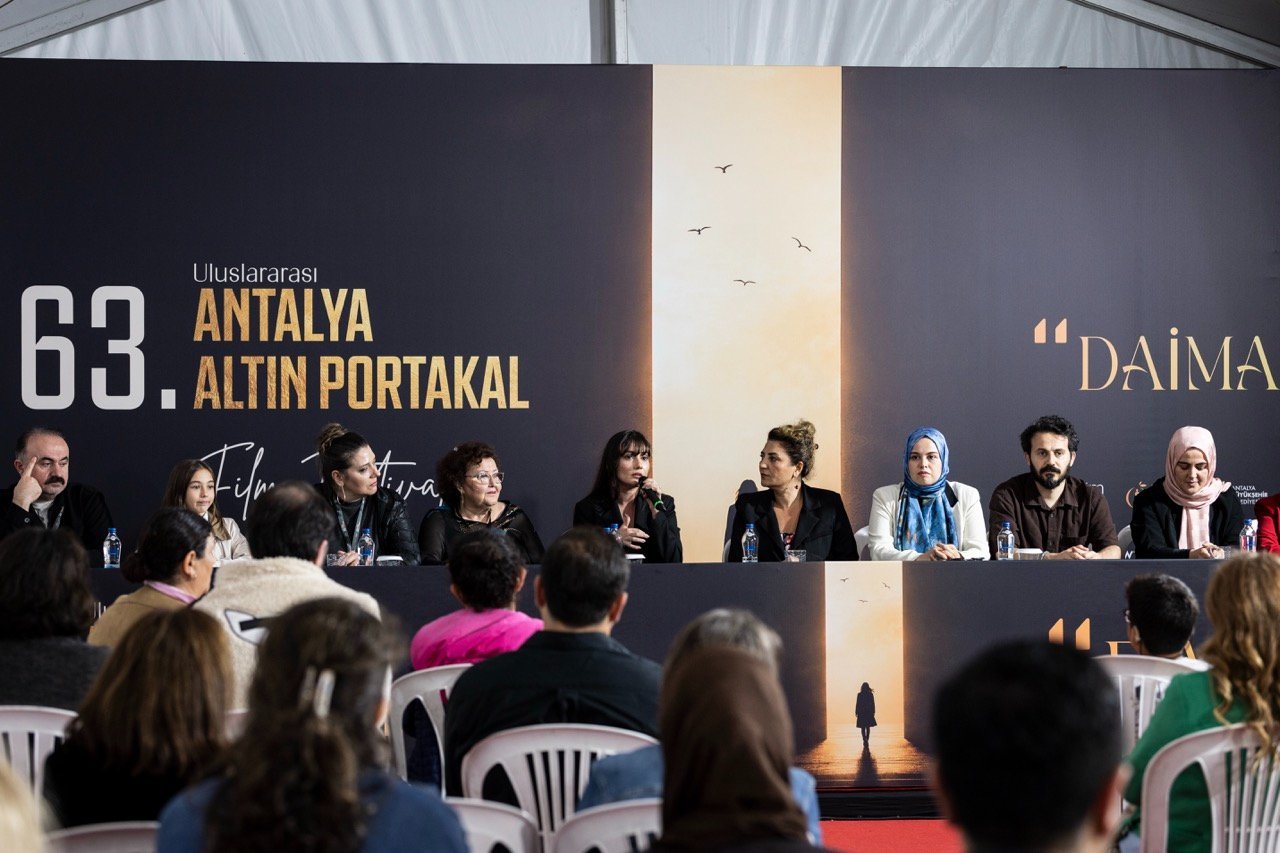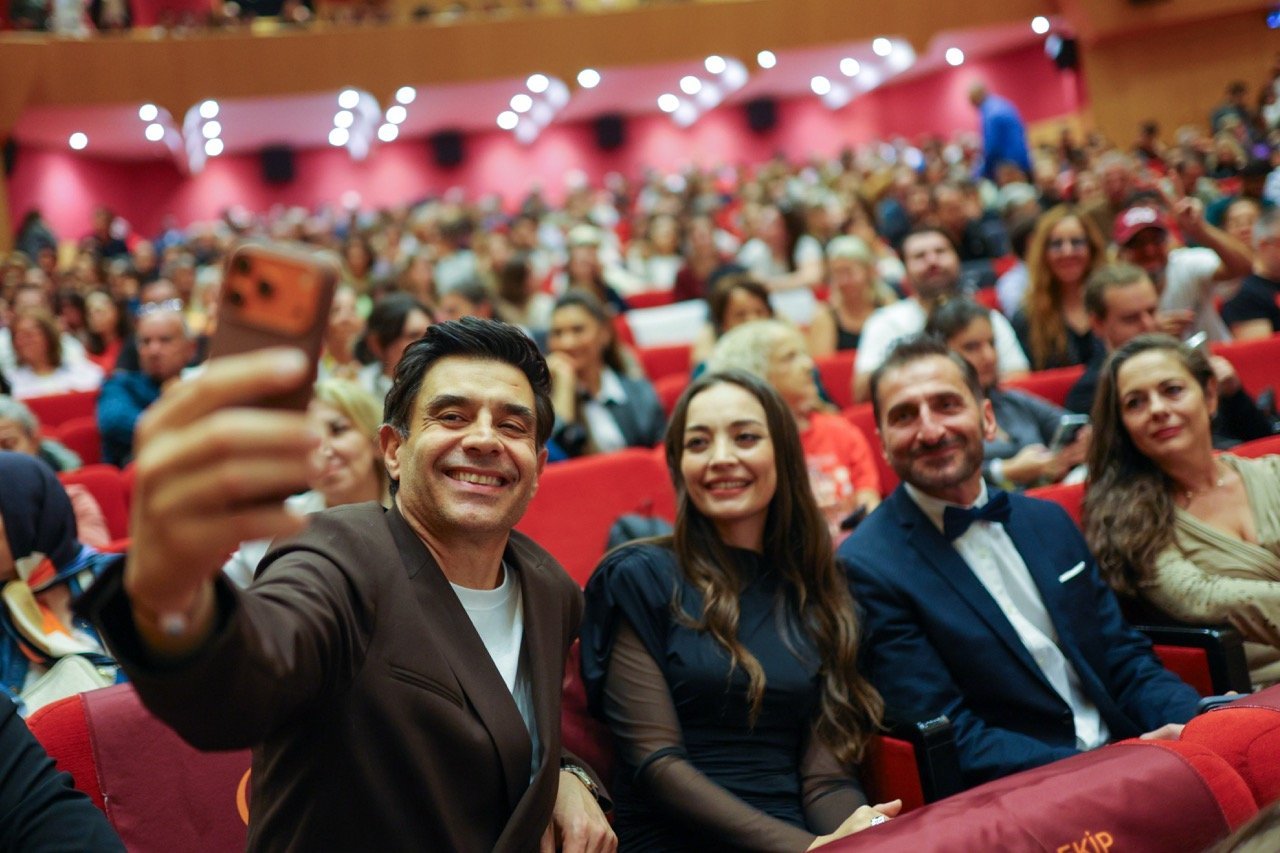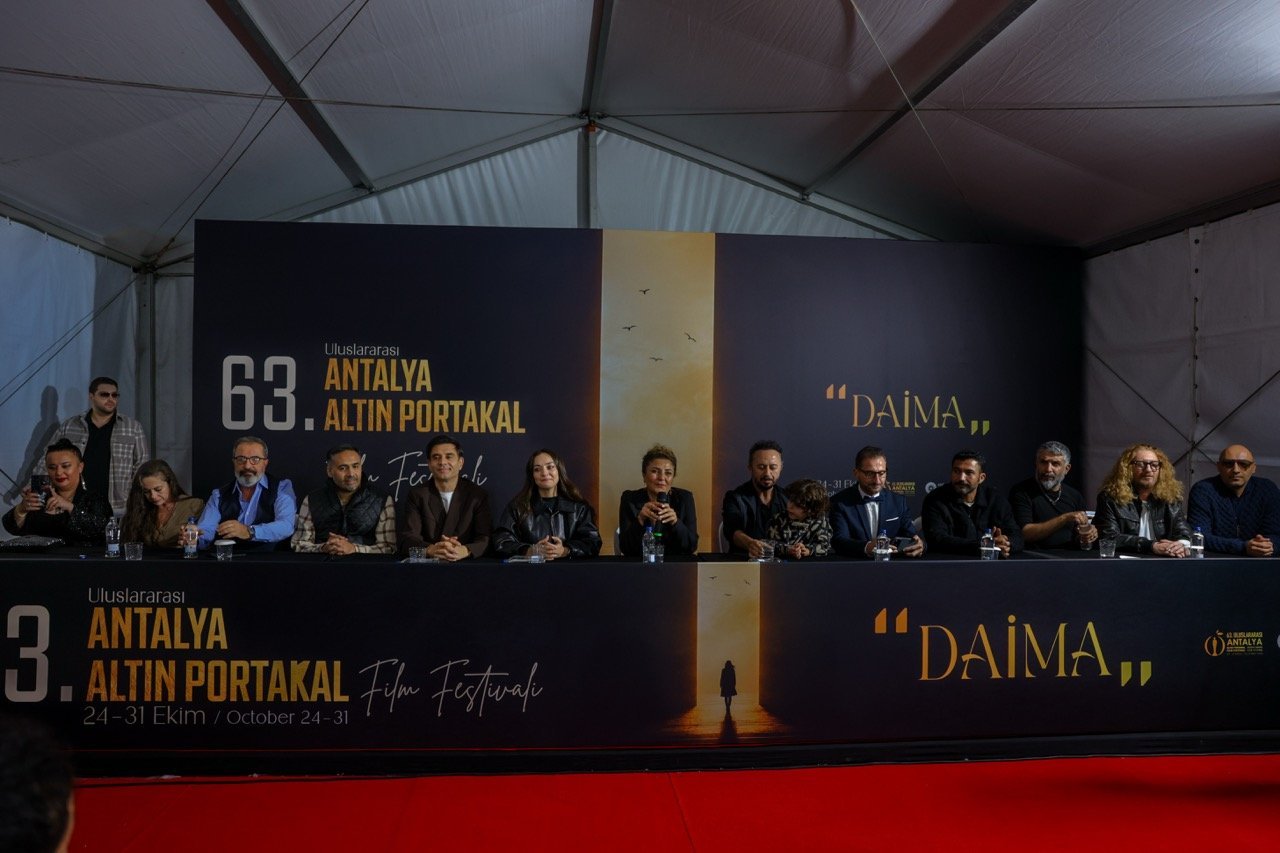
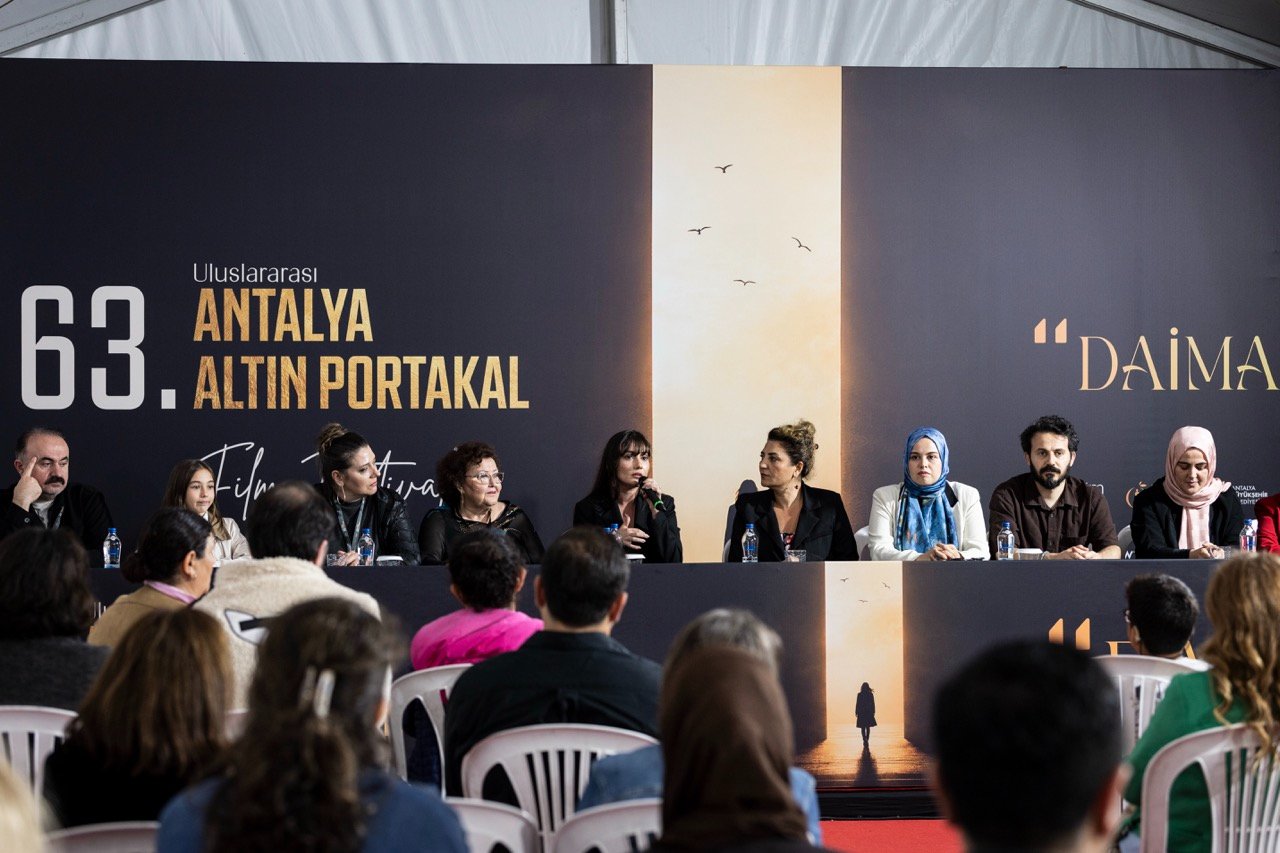
The excitement surrounding the Golden Orange Film Festival continues to build. Today, two films from the National Feature Film Competition, “About a Mother” and “The Sting of a Dead Bee,” were screened for audiences. Following the screenings, the film crews answered questions during Q&A sessions.
Competition excitement was at its peak today at the 63rd International Antalya Golden Orange Film Festival. The National Feature Film Competition titles “About a Mother” and “The Sting of a Dead Bee” met audiences, and the film crews took part in Q&A sessions after the screenings.
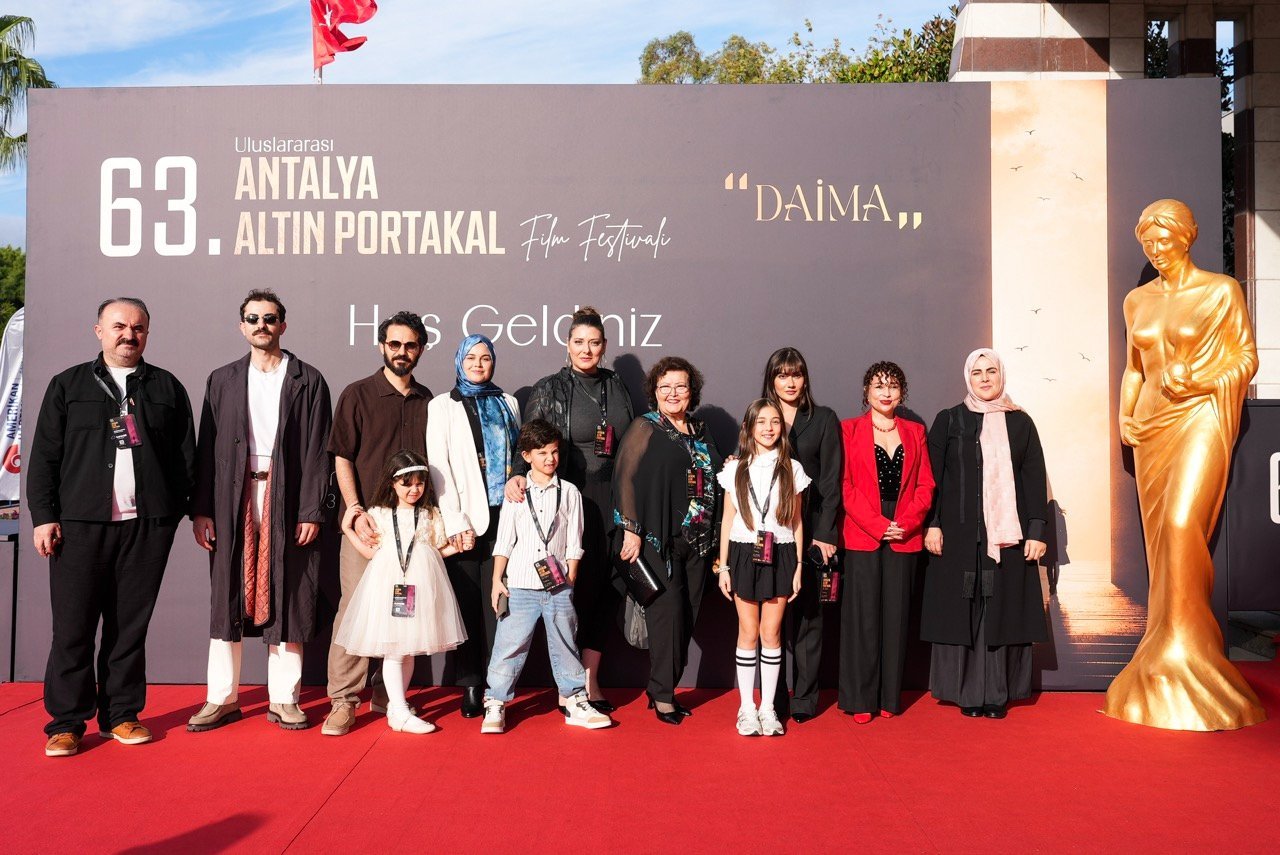
Following the screenings at the Aspendos Hall of the Atatürk Cultural Center (AKM), the first team to meet with cinema lovers was that of “About a Mother.” Writer-director Büşra Bülbül, screenwriter Bekir Bülbül, actors Sevda Erginci, Ecmel İs Ergür, Osman Doğan, Ahmet Çelik, Ümran Şakır and Duygu Köse, producer Betül Demir, and casting director Filiz Çelik answered questions.
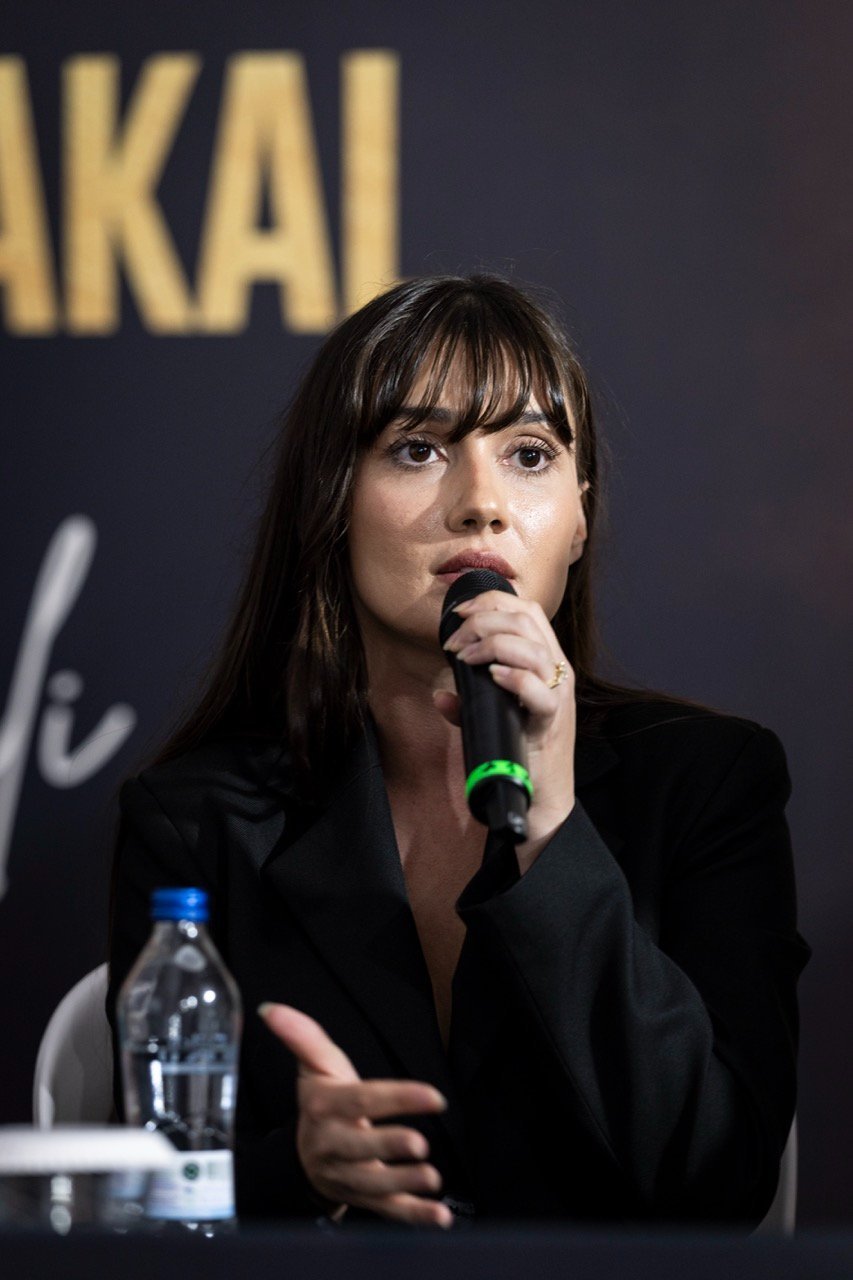
Director Büşra Bülbül spoke about the film, which explores the moral dilemma of a mother increasingly cornered by the circumstances of her life:
“The female character’s conflict with herself in the film actually emerges from her own calmness, from the moments when she remains calm. I thought I could show the intensity of her inner conflict only in quieter moments, because she is a woman who lives so calmly and minimally, almost invisibly. I wanted to portray her as a woman struggling through life: she experiences those feelings inside and does not express them outwardly very much. That is how I wanted to show her.”
Sevda Erginci, who plays the mother at the centre of the film, said the role had led her to think differently about the subject and had, in fact, changed her:
“I thought a great deal about this moral dilemma: where the boundaries lie, and for whom. I believe morality is shaped by circumstances. More precisely, I discovered this through Sibel and the role I played. As I thought about Sibel and played her, I realised that before this, I had sometimes criticised people whom I believed had crossed moral boundaries while I was sitting comfortably in my own home, in my own comfort zone. But after Sibel, I realised that moral boundaries are entirely connected to circumstances. As for where Sibel crosses that line, she is engaged in such an enormous, constant struggle that it continues even when she looks after her children as they sleep or when she laughs. She has reached her breaking point, and at the end of the day, under the pressure of necessity, she inevitably erupts in this way.”
Ecmel İs Ergür offered a different perspective: “We keep putting all the blame on Sibel, but have you ever noticed that what pushes her towards what is considered immoral is the immorality of her own brother and sister-in-law? It was her family that drove her into that difficult path and desperation. This is what affects me most, because in the end, the entire burden falls on Sibel.”
Casting director Filiz Çelik also emphasised that the film was “a women-led project”: “The director, lead actor, producer and casting director are all women in this film. And a woman is not a woman’s wolf, but her home and refuge; that is how we experienced it, too. The film also addresses women’s issues through its subject matter, and I am especially happy about that.”
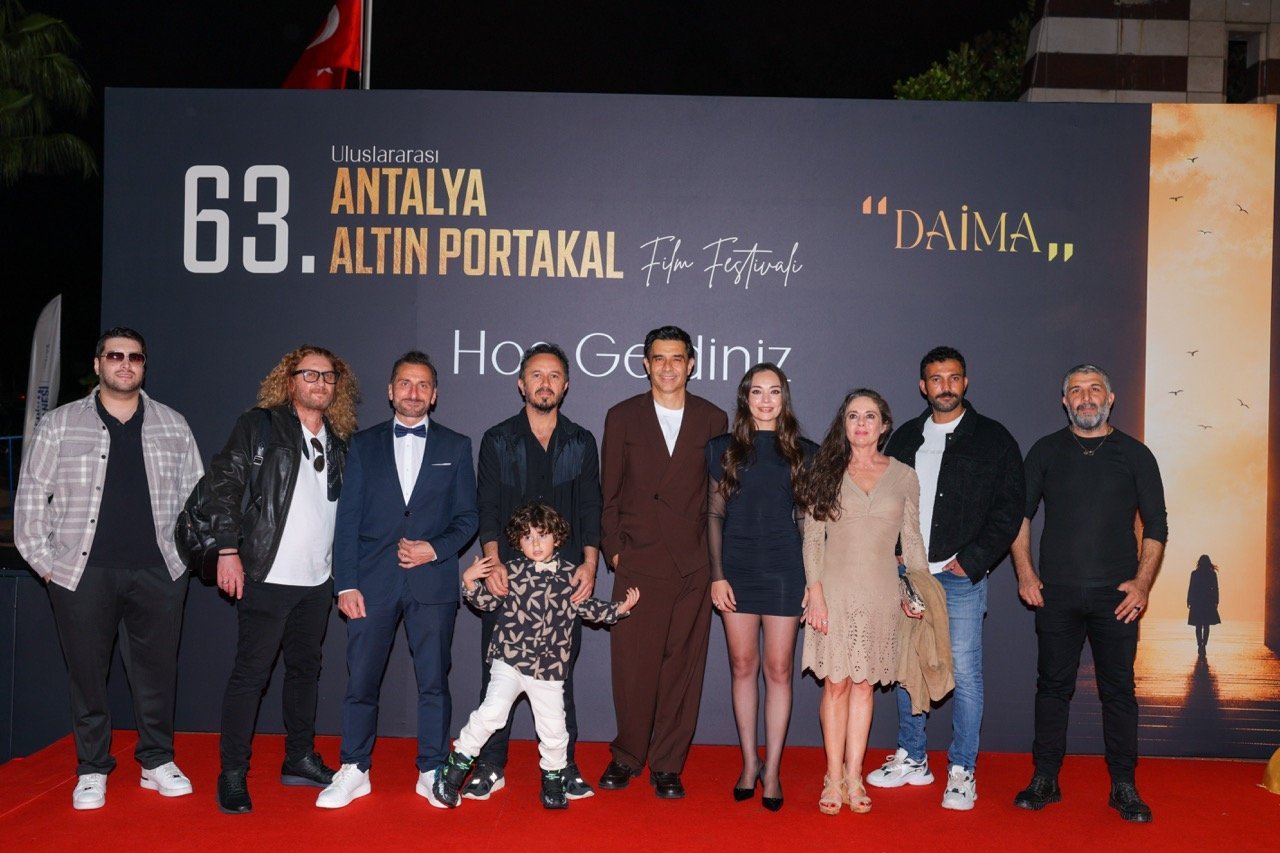
The team behind the day’s second competition film, “The Sting of a Dead Bee,” also met with cinema lovers after the screening. Director Aydın Orak and actors Cansel Elçin, Nilüfer Açıkalın, Tim Seyfi, Mehmet Çepiç, Zeynep Tuğçe Bayat, Mustafa Çavuş and Salih Yıldırım attended the session. The film explores guilt, grief and family bonds through the relationship between Yusuf, a lawyer who accidentally causes the death of his two-month-old baby, and his wife Ayşe. Director Aydın Orak explained the story’s starting point:
“The starting point of the story is this: about two months after I became a father, we faced a situation like this, although, of course, it did not actually happen. But I imagined a whole world around the question, ‘What if it had?’ How would a person then confront their conscience and their mistake, and how could they overcome it? At its heart, the story is about conscience. People can experience different things in different situations and environments, professionally or within their families, but wherever they are, they are accompanied by their own conscience. In some ways, this character is me and my contradictions. You can be a vegetarian and still kill a fly—or you might not kill a fly but kill a bee. Human beings are complicated, full of contradictions, both good and bad. I wanted to portray this contradiction through a particular kind of person.”
Cansel Elçin, who plays Yusuf, the lawyer at the centre of the story, said he was initially reluctant to accept the role because of the weight of the story:
“To be honest, it was difficult. I struggled with it psychologically because we have a son, too. When Tuğçe first sent me the story, I didn’t want to act in it because it is such a devastating tragedy. On the other hand, I didn’t see it at first, but the story is actually about a woman, told from a man’s perspective. That was what I liked most about it.”
Picking up where Elçin left off, Zeynep Tuğçe Bayat described her relationship with her character:
“It was genuinely very difficult for me, but at the same time, it was just as easy. You don’t have to experience something yourself to play a role; you don’t have to be a murderer to play one, or a mother to play a mother. That is precisely what makes this work valuable, and why we do it. I am an actor who loves preparation, but sometimes over-preparing and being a perfectionist can mean putting obstacles in your own way. Sometimes you need to let go and be present in the moment. My son was six months old while we were shooting the film, so I was very afraid, both because of the film itself and because of separating the film from my own life. But my son helped me dive into this film without over-preparing, and I am very grateful to him for that. I did not judge Ayşe. They say that once you become a mother, you understand your own mother; I understood Ayşe, too. As a mother, you face such difficult struggles that, when necessary, you do not tell the person beside you, ‘You are to blame; this happened because of you.’ In this film, the woman may seem to remain in the background, but she has to carry every emotion at once and remain strong even when storms are raging inside her. I think this is, in fact, a portrait of society.”
Veteran actor Nilüfer Açıkalın shared her feelings about the film:
“First of all, I have to say that I watched a film that deeply moved me.” I also loved the screenplay when I read it, and I am happy to have worked with such wonderful actors. This is a question of morality, conscience and compassion. Through a tragedy, we examine the relationship between women and men and witness the pain experienced by both. In the end, uncertainty prevails; it is a decision as powerful as the tragedy itself. I found the ending very moving.”
Mehmet Çepiç, recalling that he and Nilüfer Açıkalın had also attended the Golden Orange together in 2008, shared her views on the film’s ending: “Aydın and I talked a great deal about the ending. There were several possible endings, but this one felt much more right. As for my character, the film examines conscience, but I play a man who is utterly without conscience—a man capable of making others suffer death for the sake of his own child’s life. I think it is very important to bring such a lack of conscience into view within this kind of moral reckoning.”
https://antalyaff.com/tr/